
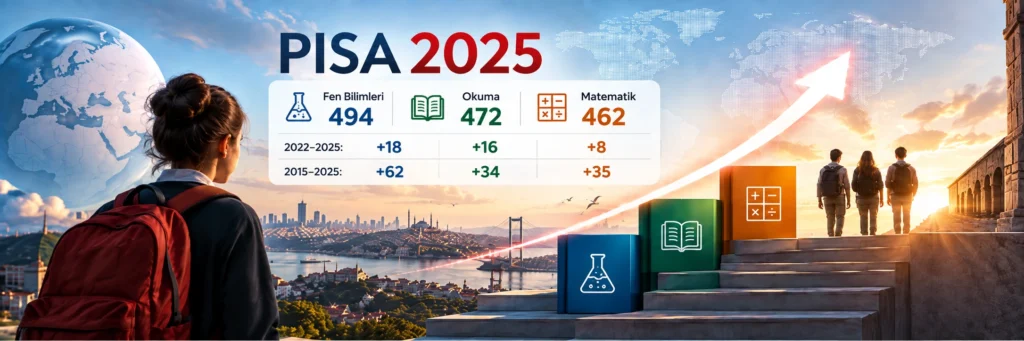
The past ten years of PISA data show that Türkiye has diverged markedly from overall OECD trends in science, reading and mathematics.
What I find particularly important in the 2015–2025 data is this: Türkiye’s improvement is not limited to a single PISA cycle. According to the OECD’s long-term trend tables and the Ministry of National Education’s assessment based on these data, Türkiye is the only OECD member country to show a positive long-term trend in all three domains: science, reading and mathematics. For this reason, it would be incomplete to interpret the PISA 2025 results solely through changes in scores over the past three years.
According to the results announced on 8 September 2026, Türkiye scored 494 points in science, 472 in reading and 462 in mathematics. It performed above the OECD average in science and reading. In mathematics, however, the difference between Türkiye and the OECD average was not statistically significant (OECD, 2026a, 2026b).
The comparison with 2022 points in the same direction. The OECD’s main report gives the changes in Türkiye’s scores between 2022 and 2025 as +18 points in science, +16 in reading and +8 in mathematics (OECD, 2026a).

Figure 1. Changes in Türkiye’s performance across the three main PISA domains between 2022 and 2025.
An increase in scores over a single PISA cycle is, of course, important. But from the perspective of an education system, a more meaningful question is this: Is this change temporary, or is it part of a longer-term trend?
In the OECD’s analysis covering 2015–2025, Türkiye’s ten-year trend is +62 points in science, +34 in reading and +35 in mathematics. Over the same period, the average trends for the 35 OECD countries with comparable data are −7, −27 and −24 points, respectively (OECD, 2026a).
What I find important in these data is not simply that Türkiye’s scores have risen. The fact that Türkiye moved in the opposite direction while the OECD average declined in all three domains over the same period makes its long-term trend more meaningful.

Figure 2. Long-term performance trend, 2015–2025.
The rankings changed in the same direction. According to the results published by the Ministry of National Education (MEB), Türkiye rose among OECD countries from 29th to 14th in science, from 30th to 13th in reading and from 32nd to 23rd in mathematics (MEB, 2026a).

Figure 3. Changes in Türkiye’s ranking among OECD countries.
In a video message published by the Ministry, Andreas Schleicher, the OECD Director for Education and Skills, also drew attention to the change in Türkiye, describing its PISA 2025 performance as “a success story that the whole world should examine carefully” (MEB, 2026b).
The results we see today in an assessment such as PISA cannot be attributed to a single school year. The performance of a 15-year-old student today is shaped jointly by teaching experiences in previous years, school conditions, curricula, approaches to assessment and the social environment in which the student lives.
For this reason, the results should not be interpreted as the product of a single year or a single reform. In its review of Türkiye published in 2023, the OECD examined education reforms over the previous twenty years in terms of access, quality and equity. It considered the move towards student-centred and competency-based curricula, access to education for disadvantaged groups, institutional capacity and system-level planning efforts (OECD, 2023).
At the OECD meeting in Bratislava where the PISA 2025 results were announced, Minister of National Education Yusuf Tekin also listed increased resources allocated to education, expanded access, improvements in classroom capacity, a reduction in the number of students per teacher, the FATİH Project and investments in digital infrastructure among the main steps taken in recent years (MEB, 2026c).
One of the indicators I consider more important than average scores is the change in the proportion of students performing below the baseline proficiency level. According to the OECD, compared with 2015, this proportion decreased in Türkiye by 25 percentage points in science, 16 in reading and 16 in mathematics (OECD, 2026b). This finding shows that the improvement has not been limited to the highest-performing group; more students have moved above the baseline proficiency threshold.
What Can the PISA 2025 Results Tell Us About the TYMM?
The dates matter here.
The Türkiye Century Education Model (Türkiye Yüzyılı Maarif Modeli, TYMM) began to be implemented gradually in the 2024–2025 school year, starting with preschool, Grade 1, Grade 5, preparatory classes and Grade 9. PISA 2025 was administered in Türkiye between 14 April and 16 May 2025 (MEB, 2024, 2026a).
For this reason, it would not be accurate to describe Türkiye’s PISA 2025 success as a direct result of the TYMM.
The main assessment of the TYMM will be possible in the coming years. How the current positive trend develops under the new curriculum approach is particularly worth monitoring. The model incorporates conceptual and domain-specific skills, problem-solving, systems thinking, various literacies, evidence of learning and differentiation into the structure of curricula (MEB, 2025a, 2025b).
From a curriculum development perspective, I see a clear conceptual similarity between these elements of the TYMM and PISA’s approach, which is based on applying knowledge in new and real-life contexts. At the same time, this similarity between the TYMM’s skills- and literacy-oriented structure and PISA’s assessment approach provides a promising basis for the years ahead.
For this reason, I think it is more appropriate to view the TYMM not as a retrospective explanation for today’s PISA scores, but as a new curriculum framework with the potential to sustain and further advance the positive trend already achieved. If the skills-based structure envisaged by the model is strongly reflected in classroom practice, the current positive trend may be strengthened further.
When we look at ten years of data, we need to consider the change in Türkiye’s performance within a broader framework than individual score increases. At a time when performance in reading and mathematics in particular declined across the OECD, Türkiye’s positive divergence in all three domains is a development of considerable significance for the education system and provides a concrete basis for optimism about the future.
In my view, the PISA 2025 results should not be underestimated. Türkiye’s long-term improvement in science, reading and mathematics, in contrast to the overall decline across the OECD, is both a significant achievement today and a hopeful starting point for the coming years. These results are also valuable because they show that an education system can change direction and that long-term efforts can produce results.
The main question from now on is to what extent this positive trend can be sustained and how progress can be distributed more evenly across different student groups. The TYMM has an important opportunity here. Its emphasis on skills-based teaching, differentiation, literacies and evidence of learning may help strengthen the current trend to the extent that these elements are reflected in classroom practice. It is still too early to see its impact; however, the conceptual similarity between the direction of the model and the competencies assessed by PISA provides reasonable grounds for optimism about the future.
For this reason, I see PISA 2025 not merely as a positive result, but as a concrete indication that Türkiye can establish a stronger performance trajectory in education. If this trend is sustained in the coming years, equity is strengthened and the TYMM finds a place in classroom practice, the picture we see today could be taken further.
References
Millî Eğitim Bakanlığı. (2024, 17 Ağustos). Türkiye Yüzyılı Maarif Modeli’ne ilişkin genelge yayımlandı. https://www.meb.gov.tr/turkiye-yuzyili-maarif-modeline-iliskin-genelge-yayimlandi/haber/34511/tr
Millî Eğitim Bakanlığı. (2025a). Türkiye Yüzyılı Maarif Modeli Öğretim Programları Ortak Metni. https://tymm.meb.gov.tr/ortak-metin
Millî Eğitim Bakanlığı. (2025b). Türkiye Yüzyılı Maarif Modeli: Programlar arası bileşenler. https://tymm.meb.gov.tr/programlar-arasi-bilesenler
Millî Eğitim Bakanlığı. (2026a, 8 Eylül). PISA 2025 sonuçlarına göre Türkiye, her alanda “en fazla yükselen ülke” oldu. https://www.meb.gov.tr/pisa-2025-sonuclarina-gore-turkiye-her-alanda-en-fazla-yukselen-ulke-oldu/haber/41822/tr
Millî Eğitim Bakanlığı. (2026b, 9 Eylül). OECD’den Türkiye’nin PISA başarısına övgü: “Tüm dünyanın dikkatle incelemesi gereken bir başarı hikâyesi”. https://www.meb.gov.tr/oecdden-turkiyenin-pisa-basarisina-ovgu-tum-dunyanin-dikkatle-incelemesi-gereken-bir-basari-hikayesi/haber/41852/tr
Millî Eğitim Bakanlığı. (2026c, 8 Eylül). Bakan Yusuf Tekin, “PISA 2025 Bölgesel Toplantısı”nda Türkiye’nin başarısını anlattı. https://www.meb.gov.tr/bakan-yusuf-tekin-pisa-2025-bolgesel-toplantisinda-turkiyenin-basarisini-anlatti/haber/41834/tr
OECD. (2023). Taking stock of education reforms for access and quality in Türkiye (OECD Education Policy Perspectives No. 68). OECD Publishing. https://doi.org/10.1787/5ea7657e-en
OECD. (2026a). PISA 2025 results (Volume I): Future-ready students. OECD Publishing. https://doi.org/10.1787/73451bc5-en
OECD. (2026b). PISA 2025 results (Volume I): Türkiye—Country note. OECD Publishing. https://www.oecd.org/en/publications/pisa-2025-results-volume-i-country-notes_2d4ff9ea-en/turkiye_3f140b0d-en.html
Discover more from EdTech Compass
Subscribe to get the latest posts sent to your email.