
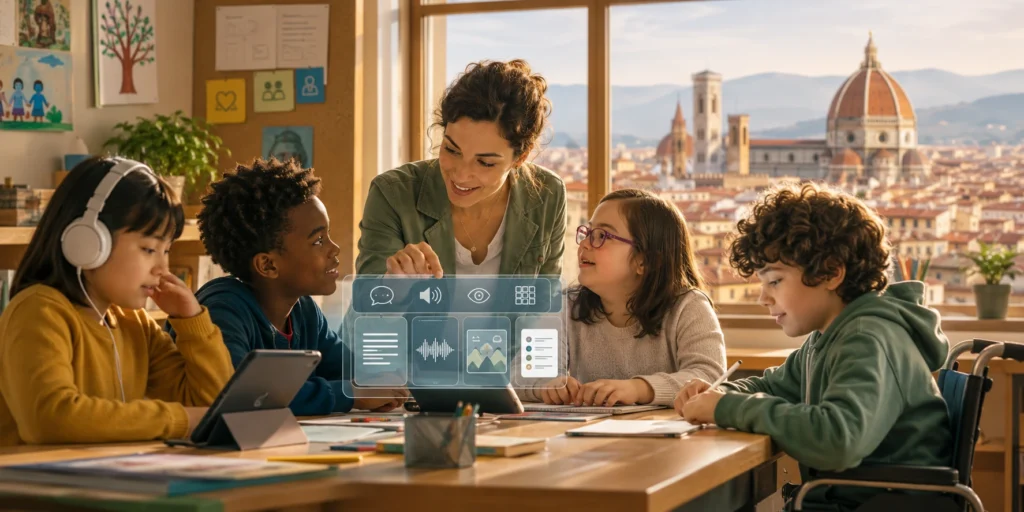
Artificial intelligence is entering the world of education at remarkable speed, yet we often find ourselves circling around the same question: Will this technology replace teachers, or will it empower them? The “Inclusive Teaching with Artificial Intelligence” course we attended in Florence made me realize that this question is, in fact, incomplete. The real issue is not simply whether artificial intelligence enters the classroom, but with what intention, pedagogical responsibility, and human-centered perspective it does so. Technology becomes educationally meaningful only when it helps teachers see, understand, and support their students more effectively.
Within the scope of the Erasmus+ School Education Accreditation project carried out by the İzmir Provincial Directorate of National Education, I participated in this international course in Florence, Italy, together with two teacher colleagues from Ankara Primary School. As someone involved in the writing and coordination of the project process, this mobility was not merely a professional development activity for me. It offered a more concrete, classroom-based, and practice-oriented opportunity to reconsider issues I have long been reflecting on: inclusive education, teacher agency, and AI-supported instructional design.
One of the concepts that stayed with me most strongly throughout the course was inclusion. Inclusion is often used as a well-intentioned but broad expression. Yet when we return to the classroom, it becomes a set of very concrete questions: What do we do when a student cannot access a text? How do we support a student who understands a mathematical operation but gets lost in symbols? How do we redesign an activity for a child who cannot follow long instructions? What alternative means of expression can we offer to a student who struggles to express themselves in writing?
These questions reminded me once again that inclusion does not mean giving everyone the same thing. Trying to reach every student with the same text, at the same pace, and through the same method may look like equality from the outside; however, when learning needs differ, equality alone may not be enough. What is fair is to open the path that each student needs in order to participate in learning. Simplifying a text for a student with dyslexia, breaking instructions into steps for a student who struggles to sustain attention, providing visual support for a student with a different language background, or preparing a concept map for a child who has difficulty with abstract ideas does not lower the quality of instruction; on the contrary, it strengthens the right to learn. Universal Design for Learning is also grounded in the idea of designing learning environments from the outset to be more accessible, flexible, and inclusive (CAST, 2024).
AI tools begin to gain real meaning precisely at this point. However, there is a critical distinction here: artificial intelligence should not be seen as a decision-maker replacing the teacher, but as an assistant that supports the teacher’s pedagogical decisions. There is a significant difference between asking a tool simply to “prepare an activity” and asking it to “prepare a three-stage reading activity for fourth-grade students at risk of dyslexia, using short sentences, visual support, and simplified instructions.” This difference does not arise merely from technological competence; it comes from knowing the student and establishing a clear instructional intention.
For this reason, one of the most valuable gains of the course for me was improving my ability to write effective prompts. A prompt is often seen as a technical command; however, it is actually the verbal expression of the teacher’s pedagogical design. For whom? At what level? For what purpose? With which limitations in mind? In what output format? Unless these questions are clarified, the output received from artificial intelligence often remains superficial. The meaningful use of generative AI in education requires a human-centered, safe, and pedagogically purposeful approach (Miao & Holmes, 2023).
During the course, we had the opportunity to try various tools in practice, including Gemini/Gems, NotebookLM, Gamma AI, Napkin AI, Diffit, Suno AI, Google AI Studio, ElevenLabs, Photomath, and WolframAlpha. Yet for me, what mattered was not the names of the tools themselves, but which learning needs they could address. Gemini/Gems stood out in generating stories and activities appropriate to students’ levels. NotebookLM was useful in transforming scattered resources into a meaningful learning guide. Gamma AI and Napkin AI were notable for visualizing texts and structuring concepts. Diffit offered a particularly strong possibility for inclusive teaching by adapting the same topic to different reading levels and generating worksheets. Producing rhythmic and auditory content with Suno AI, as well as preparing audio materials with Google AI Studio and ElevenLabs, showed that learning does not have to proceed only through written texts.
The work we did with tools such as Photomath, WolframAlpha, and similar applications in the context of mathematics learning difficulties was also thought-provoking. In mathematics, the problem is sometimes not that the student cannot find the answer, but that they cannot identify where the reasoning process breaks down. AI-supported tools can be used here not merely as systems that provide answers, but as supports that make the thinking process visible. Of course, not every output should be accepted as accurate, reliable, or pedagogically appropriate. The use of AI in education particularly requires teachers to exercise critical evaluation, data awareness, and ethical responsibility (European Commission, 2022). Therefore, the teacher is not someone who directly accepts AI-generated output; rather, the teacher is the key actor who reviews, adapts, and reinterprets it according to the classroom context.
One of the strongest impressions the Florence experience left on me was that inclusive education is not only a local need but also a universal responsibility. Sharing the same learning environment with teachers from different countries, presenting our school and country, listening to different educational cultures, and seeing that similar problems are addressed through different solutions all broaden a teacher’s perspective. Although classrooms may differ, the core issue is often the same: every child should be able to access learning, feel valued, not have their difference perceived as a deficiency, and be visible in the classroom.
In our final course project, we tried to embody this perspective. We focused on developing an inclusive product by using visuals, audio, subtitles, plain language, and multiple means of representation. For me, this was not merely a technical output; it was a small but meaningful application of the inclusive design perspective we had discussed throughout the course. Inclusive teaching often begins not with grand statements, but with small design decisions. Simplifying an instruction, adding audio to a text, visualizing a concept, or offering students different ways to express themselves can create meaningful differences in the classroom.
Of course, the real value of this mobility should not remain in Florence. Erasmus+ experiences become truly meaningful not only when they contribute to the individual development of participating teachers, but when they are transformed into school culture and professional sharing. For this reason, we plan to carry out dissemination activities at Ankara Primary School on AI-supported inclusive teaching tools. Our aim is not only to introduce these tools, but also to discuss with teachers how they can be used according to classroom needs, develop examples together, and identify small, applicable steps.
Today, when artificial intelligence is discussed in education, the brightness of the tools can sometimes overshadow the real issue. What matters is not which tool is more popular, but for which student, in response to which learning need, and with what ethical responsibility the tool is being used. Artificial intelligence can offer a powerful opportunity for inclusive education; however, this opportunity can become meaningful only when the teacher knows the student, understands the classroom context, and preserves pedagogical decision-making responsibility. Educational technologies are meaningful only when they are used in ways that are appropriate, equitable, sustainable, and in the best interest of the learner (UNESCO, 2023).
For me, the course in Florence offered an opportunity to rethink the role of artificial intelligence in education. It reminded me once again that we should use AI not merely to produce materials more quickly, but to design learning environments that are more equitable, more accessible, and more inclusive. In education, technology is never an end in itself. The real purpose is to strengthen the child’s right to learn, support the teacher’s professional judgment, and transform the classroom into a more humane learning space.
Education is the future. Yet as we design this future, we must look first not to technology but to the human being; not to the tool but to the child; not to the output but to the right to learn.
References
CAST. (2024). CAST Universal Design for Learning Guidelines version 3.0. https://udlguidelines.cast.org/
European Commission, Directorate-General for Education, Youth, Sport and Culture. (2022). Ethical guidelines on the use of artificial intelligence and data in teaching and learning for educators. Publications Office of the European Union.
Miao, F., & Holmes, W. (2023). Guidance for generative AI in education and research. UNESCO.
UNESCO. (2023). Global education monitoring report 2023: Technology in education—A tool on whose terms? UNESCO.
Discover more from EdTech Compass
Subscribe to get the latest posts sent to your email.