
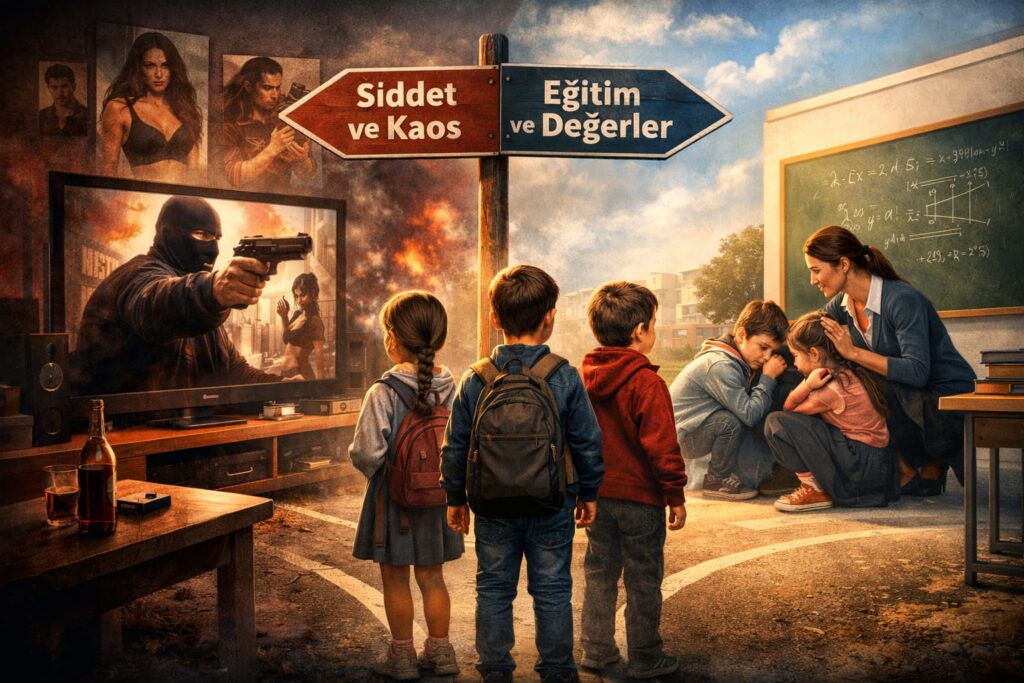
To understand what a country is truly teaching its children, one must sometimes look not at the official curriculum, but at the hidden curriculum that begins after working hours end.
Because children do not grow only in classrooms. Their real formation often begins after the school day is over. It continues in the glow of television screens, in the language of serial dramas, in the tone of the news, in the brutality of social media, and in the anger of adults. Whatever the school tries to construct during the day, society either reinforces at night or quietly dismantles.
Today, in many parts of the world, this is one of the most pressing issues we face. In the classroom, the teacher tries to cultivate patience, respect, dialogue, coexistence, and the ability to live with difference. Yet once school ends, another curriculum takes over: a silent but deeply influential curriculum. In this invisible lesson, problems are not resolved through dialogue but through suppression. Power displaces truth. Violence is presented as a language of resolution. Masculinity is confused with rudeness, authority with fear, determination with hardness. Women are devalued, relationships are distorted, and compassion is framed almost as a weakness.
The school attacks that have occurred in rapid succession across different parts of the world in recent years have brought this contradiction before us in a form too painful to ignore. These tragedies, unfolding in different geographies, remind us once again that school safety is not merely a matter of building entrances, surveillance cameras, or teacher duty rotations. The issue is a much deeper social fracture.
We must be honest here. No television series produces a killer on its own. No single scene causes a school attack by itself. To reduce profound tragedies to a single cause is to oversimplify reality. Youth violence is shaped by many interrelated factors: domestic conflict, social inequality, mental health challenges, weak school attachment, easy access to weapons, and broader environmental risks. Yet this is precisely why we must speak about the cultural climate.
While children and teachers are dying somewhere in the world, the evening news debates the causes; and the moment the broadcast ends, the screen begins to speak the same language again: war, mafia, the underworld, revenge, power, elimination, domination. Across mainstream broadcasting there are different genres on different channels, yet the emotional backbone is nearly identical. In one place, war; in another, crime; elsewhere, mafia, the underworld, ruthless competition, or power games. The genres may change, but the feeling repeatedly placed before children and society remains the same: conflict. That is exactly the point. We discuss violence after it happens, yet every evening we reproduce the cultural climate that nourishes it.
Because the most powerful lesson society teaches children is often not what it explicitly says, but what it repeatedly normalizes. If, during prime-time broadcasting, anger is made attractive, bullying is portrayed as effective, weapons are associated with strength, women are rendered degradable, and shouting is presented as a sign of legitimacy, then children are not simply watching stories; they are learning a logic of life. They observe which forms of behavior are rewarded. They see who is applauded, who is silenced, who seizes the stage through intimidation. And when school then presents them with an entirely different moral universe, they are left alone with a silent question: If this is what wins in real life, why are you teaching me the opposite?
This is where education and culture confront one another.
School says, “Violence is wrong”; the screen says, “But it works.” The teacher says, “Equality”; popular culture says, “The strong crush the weak.” The textbook says, “Empathy”; life begins to say, “Strike before you are struck.” In such a context, the child does not experience merely a cognitive contradiction; the child experiences a moral fragmentation. On one side stand values; on the other, rewarded behaviors. Unfortunately, children learn not primarily by listening to advice, but by watching what is rewarded.
One of the most unsettling questions today is this: Are we truly educating children, or are we simply reclaiming by day in school what society takes back by night?
Teachers are performing extraordinary labor in classrooms. They gather scattered attention. They try to mend broken hearts. They teach children how to translate anger into words, how to resolve conflict through dialogue, how to live together, how to wait their turn, and how to exist without harming one another. Yet by evening, it is as if another country begins. After working hours, it is as if the hidden curriculum takes over. There, the loudest wins. The harshest is perceived as strongest. The most abrasive becomes most visible. In such a cultural climate, it is profoundly unfair to leave the entire moral burden on the teacher’s shoulders.
This is not only a pedagogical issue; it is also an ethical one. To remain silent in the face of a media order that threatens children’s physical, mental, and moral development is not merely a cultural preference; it is a form of public neglect.
And this is where the real issue comes to a head: a society cannot hold schools alone responsible for the upbringing of its children. If families say one thing, screens show another, streets speak a different language, adults emit a different tone, and popular culture generates a different morality, then the school cannot remain an island of civilization on its own. If education is continuously sabotaged by the rest of society, the problem is not the inadequacy of teachers; it is the erosion of a society’s collective conscience.
One of the most enduring impressions left in our minds by The Country of the White Lilies is this: a society can rise only when all of its institutions become educative. Not only the school, but also the family, the media, politics, art, the neighborhood, language, screens, and the entirety of everyday life are part of education. For this reason, when we speak about violence in schools, we cannot imagine that installing metal detectors at the entrance, increasing the number of security personnel, or merely hardening disciplinary regulations will be enough. Yes, physical safety is indispensable. Yes, far stricter and more realistic measures are needed regarding access to weapons. But we also need a broad social mobilization—one that strengthens children’s sense of school belonging, deepens their attachment to school, expands psychosocial support, creates safe post-school social environments, equips families with media literacy, and places the public good at the center of broadcasting in a genuine way.
What we most urgently need today is more than telling children that “violence is wrong.” We need to become a social order that not only explains why violence is wrong, but makes that truth felt across every sphere of collective life. Because children learn less from admonition than from climate. And when the climate of a society deteriorates, first language hardens, then relationships decay, and in the end even school gates can no longer preserve a sense of safety.
Now we must decide: Do we truly want to educate our children, or will we continue surrendering them each evening to another curriculum and then expect miracles from schools the next morning?
Discover more from EdTech Compass
Subscribe to get the latest posts sent to your email.