
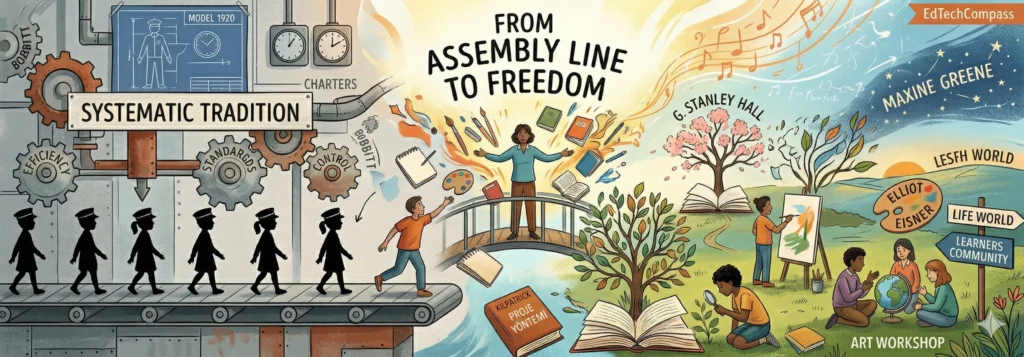
Dear EdTechCompass readers, today we will take a closer look at the contemporary classroom reflections of one of the most deep-rooted and disruptive philosophical struggles in educational history. In the early twentieth century, educational curricula acquired a new identity under the influence of the massive industrial and economic transformations occurring in the United States. The “systematic tradition,” led by theorists such as Franklin Bobbitt and W. W. Charters, conceptualized the school as a finely tuned factory, the student as raw material to be molded, and the curriculum as an assembly line that prevents social waste while reaching predetermined objectives. Rooted in behaviorist psychology and Frederick Taylor’s principles of scientific management, this approach defined the primary goal of education not as the intellectual and spiritual growth of the individual, but as the provision of social efficiency demanded by the market. Fortunately, however, the trajectory of educational history was not drawn solely by this technocratic and mechanistic vision that objectifies the human being. Against this standardizing structure, a powerful progressive and reconceptualist tradition emerged, placing human nature, freedom, lived experience, existential consciousness, and aesthetics at the center, thus initiating a century-long struggle.
The first major rupture in the idea that education should be liberated from these rigid adult-world standards and adapted to the developmental nature of the child occurred with G. Stanley Hall, one of the founders of developmental psychology. Arguing that the traditional programs prepared by the committees shaping the high school system of the era were entirely contrary to the nature of adolescents, Hall (1901) defined adolescence as a unique period of “storm and stress”—a stage where humans diverge from animals and where ideals and passion flourish. Therefore, education must move away from rigid authority imposed from the outside and embrace a flexible structure that respects the child’s nature and centers on freedom. Smith (2020) emphasizes that Hall’s approach shattered the age-old belief that the school was a fixed mold into which the child must be fitted, thereby forming the cornerstone of the “child-centeredness” principle of the progressive education movement.
The philosophy Hall advocated on a theoretical level was transformed by W. H. Kilpatrick into a powerful, revolutionary pedagogical tool directly applicable in classrooms, transcending philosophical boundaries. Stating that a regime of external coercion pushes students into a state of aimless lethargy, Kilpatrick (1918) placed “wholehearted purposeful activity” occurring in a social context at the heart of education, rather than a passive listening process. Knoll (2010) points out that Kilpatrick radically redefined the word “project,” stripping it of its traditional mechanical meaning and embedding it into the very heart of progressive education. In this model, the student is not an entity who memorizes subjects dictated by the teacher, but an agent who realizes a purpose through their own intrinsic motivation; thus, the knowledge gained ceases to be a burden to be forgotten after the exam and transforms into an experience integrated directly into life.
By the 1970s, through the work of Maxine Greene, one of the most brilliant pioneers of the reconceptualist movement, progressive thought transcended being a mere instructional method and gained a profound existential ground. Greene (1971) categorically rejected viewing the curriculum as “given objective realities” written by experts; to her, the curriculum should be a stepping stone for the individual to make sense of their own life-world and to reach toward “what is not yet.” Lundy (2025) has empirically demonstrated that the existential awareness envisioned by Greene is only possible if teachers break free from the pressures of rigid curricula and transform classrooms into art studios where students can freely construct their own meanings.
The person who formulated this search for meaning and the stance against standardization in an aesthetic dimension most powerfully was Elliot Eisner. Criticizing the construction of global educational systems upon engineering methodologies, Eisner (2008) stated that education is not a manufactured production process; it must harbor open-ended tasks, surprises, and multiple perspectives. The school can only learn this humanistic vision from the arts. Rolling (2006) also argued that art is not merely a decorative pursuit but the most essential cognitive building block required to create a full-fledged human mind, emphasizing that Eisner’s approach is the most elegant resistance against the “test culture” that mechanizes education.
This vast intellectual heritage built throughout the historical process is, unfortunately, under the threat of a bureaucratic standardization that has become increasingly aggressive in the 21st century. At this point, Alfie Kohn (2008) intervenes, rejecting the standardized test-centricity and the competitive “letter grade frenzy” that pits children against one another; he advocates for schools to be learning communities that view learning as a journey rather than a destination. The work of Gambone (2017) also shows that being a progressive educator in the current system—dominated by rigid accountability policies—requires being something of a social justice activist and building professional solidarity networks by taking significant risks to provide meaningful learning environments for children. In conclusion, this century-old philosophical bridge proves to us that education is not a set of externally imposed rules or a series of memorized facts; on the contrary, it is a profound life practice through which the student aesthetically and consciously reconstructs themselves, society, and “that which is not yet.” Contemporary curriculum development efforts must cease focusing solely on efficiency calculations and embrace this humanizing and liberating legacy of education much more strongly.
References
- Eisner, E. (2008). What education can learn from the arts. LEARNing Landscapes, 2(1).
- Gambone, M. A. (2017). Teaching the possible: Justice-oriented professional development for progressive educators. Brock Education: A Journal of Educational Research and Practice, 27(1), 22-38.
- Greene, M. (1971). Curriculum and consciousness. Teachers College Record, 73(2), 253-269.
- Hall, G. S. (1901). How far is the present high-school and early college training adapted to the nature and needs of adolescents? New England Association of Colleges and Preparatory Schools.
- Kilpatrick, W. H. (1918). The project method: The use of the purposeful act in the educative process. Teachers College Record, 19(4), 319-335.
- Knoll, M. (2010). “A marriage on the rocks”: An unknown letter by William H. Kilpatrick about his project method. ERIC Document Reproduction Service.
- Kohn, A. (2008). Progressive education: Why it’s hard to beat, but also hard to find. Independent School.
- Lundy, J. (2025). Curriculum enacted as the aesthetic in British Columbia: Where are we now? Where can we go? And how might we get there? Canadian Journal for New Scholars in Education, 16(2), 85-93.
- Rolling, J. H. (2006). Essay review of “The arts and the creation of mind” by Elliot Eisner. Journal of Curriculum Studies, 38(1), 113-125.
- Smith, E. G. (2020). The changing perspective on adolescence. Conspectus Borealis, 5(1), 1-8.
Discover more from EdTech Compass
Subscribe to get the latest posts sent to your email.